
A Community Guide to Puanga: Celebrating the Māori New Year
Every year, Māori look to the skies to mark the end of one year and the beginning of the next. Because Puanga / Matariki follows the Maramataka (Māori Lunar Calendar) it does not have a set date but falls at different dates in the middle of the year. While many communities across Aotearoa focus on the star cluster Matariki, for those of us on the West Coast, in the Far North, and on parts of the South Island, it is the star Puanga that signals the passage of time and guides the months ahead.
1. What is Puanga?
Puanga is the star known in Western astronomy as Rigel, the brightest star in the Orion constellation (and the fifth brightest star in the entire night sky).
While Matariki is a cluster of stars, Puanga is an individual, highly prominent star. Rather than seeing them as competing traditions, it is important to understand that both are special and significant; they are both part of the Māori New Year (Te Mātahi o te Tau).
2. Why do some iwi look to Puanga instead of Matariki?
The choice to look to Puanga is largely geographical.
Because of mountain ranges, weather patterns, and local horizons, some iwi—particularly those of us in Taranaki, Whanganui, parts of the Far North (Te Tai Tokerau), and parts of the South Island—cannot see Matariki clearly from their traditional localities. Instead, they focus on Puanga, which sits much higher in the winter night sky and is easily visible from the west at the same time Matariki rises in the east.
Choosing Puanga is not a rejection of Matariki. Many of these iwi still feature Matariki in their narratives, but Puanga is given practical preference as their local celestial guide.
3. How to Find Puanga in the Night Sky
Finding Puanga is easy once you locate Tautoru (Orion’s Belt), which looks like three bright stars in a straight line (often referred to as the “Pot”).
- Go outside in the early morning before dawn during winter (June/July).
- Look toward the eastern horizon and locate the three stars of Tautoru.
- Look directly above Tautoru. You will see a single, exceptionally bright star—that is Puanga. (Note: Matariki can usually be found lower in the sky and to the left of Tautoru).
4. Cultural Meanings & Practices
The Māori New Year is a sacred time of renewal, reflection, and connection to both the sky and the earth. Traditional values observed during Puanga include:
- Remembering Loved Ones: When Puanga sets, it is a quiet time to reflect on the past year and remember those who have passed away. When Puanga rises again in the eastern sky, it signifies the spirits of those loved ones becoming stars, prompting communities to prepare for the New Year celebrations.
- Harvest and Abundance (Puanga kai rau): The common proverb “Puanga kai rau” translates to “The abundant harvest of Puanga.” It celebrates the hard work of growing, harvesting, and storing food to sustain the community through the long, cold nights of winter (takurua).
- Environmental Stewardship: Observing the brightness and clarity of Puanga tells tohunga (experts) what the weather and food abundance will be like for the coming year, prompting communities to align themselves with the natural environment.
- Gardening Preparation: Puanga is the time to prepare the soil (māra). The winter frosts help cleanse the dirt, killing off weeds and soil infections. This cycle mimics transitioning from Te Kore (the void/potential of the unplanted ground) to Te Pō (the darkness where seeds are planted), and finally to Te Ao Mārama (the world of light, when shoots sprout).
5. How is Puanga Celebrated?
Puanga is not a single day event. It spans roughly a month or longer, requiring two months of careful preparation beforehand and followed by two months of wānanga (learning and discussion).
Today, communities come together during Puanga to hold dawn ceremonies, share meals, pass down traditional knowledge, and set positive intentions for the year ahead.
How do we celebrate at Puketapu?
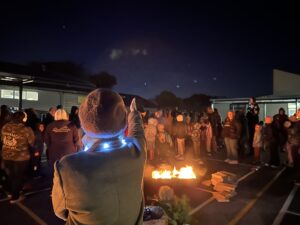
We are in our third year of celebrating Puanga and Matariki here at Puketapu School. We gather for a Hautapu ceremony, where we acknowledge the starts of Matariki and Puanga and ‘feed’ them with steam from different forms of kai aligned with different natural elements:
Tupuānuku: food from the earth
- Kūmara
- Rīwai / potato
- Kāreti / carrot
Tupuārangi: food from the sky
- Heihei / chicken
- Tītī / muttonbird
- Hua rākau / berries
Waitī: food from freshwater, such as rivers
- Tuna / eel
- Koura / freshwater crayfish
- Wātakirihi / watercress
Waitā: food from the ocean
- Tāmure / snapper
- Any type of shellfish
- Karengo / seaweed
Then we share parakuihi / breakfast together. Please stay and enjoy a delicious community breakfast with us. There will be warming delicious kai for everyone. If you would like a coffee (flat white, cappuccino or long black) then bring a gold coin donation.
After this, the student will start their activity rotations for the day, at 8am, and you are welcome to join in or come back at 1pm to collect them when the day is finished.